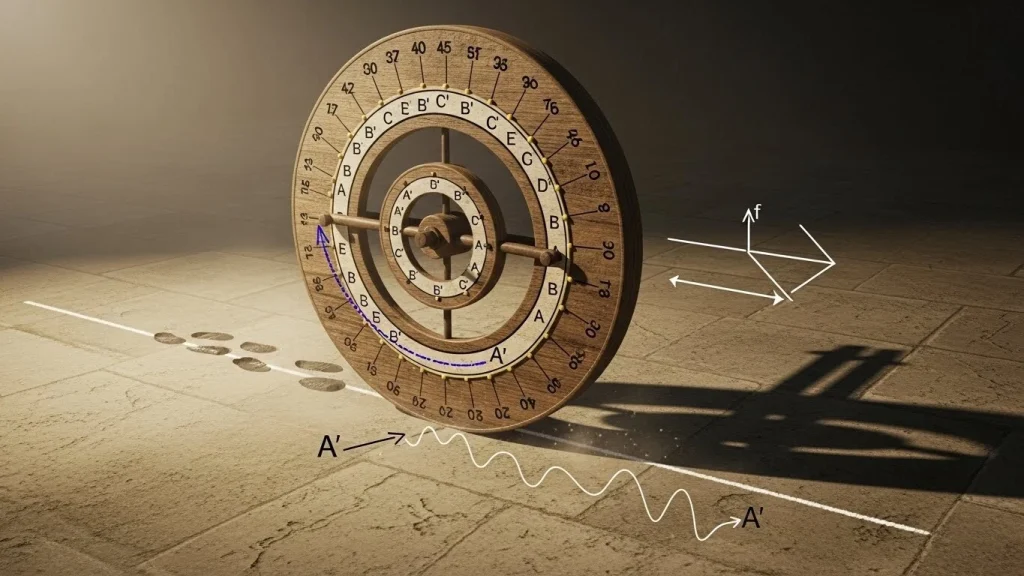
The Aristotle Wheel Paradox has puzzled thinkers for centuries, and it still captivates minds today. This paradox, also known as the “Paradox of Motion,” challenges our understanding of space, motion, and time. Aristotle’s wheel paradox suggests an intriguing and complex relationship between linear and rotational motion, forcing us to rethink the nature of motion itself. But what does it really mean? In this blog, we’ll explore the Aristotle Wheel Paradox explained, its implications it has for our understanding of physics, and how this paradox continues to inspire philosophers and scientists alike.
What is the Aristotle Wheel Paradox?
At its core, the Aristotle Wheel Paradox revolves around the behaviour of a wheel. Imagine a large wheel with a smaller wheel attached to its circumference. If the large wheel rotates, the smaller wheel is supposed to rotate as well. Aristotle proposed a paradox in which the motion of the smaller wheel is questioned. He pointed out that if you observe the motion of the smaller wheel in relation to the larger one, you might find that the smaller wheel would not move in the same way that it logically should. The paradox presents an apparent contradiction that has been the subject of much debate.
To explain this paradox further, Aristotle observed that when a wheel rolls along the ground, the point of contact between the wheel and the surface doesn’t appear to move. However, the rest of the wheel moves with respect to the surface. The apparent contradiction is that the smaller wheel, rotating at the edge of the larger wheel, seems to be moving at different speeds depending on which aspect of the wheel you are observing.
This paradox calls into question the very notion of motion in a circular system. It challenges our ability to rationalise motion and the speed at which it occurs.
Aristotle Wheel Paradox Explained: The Heart of the Puzzle
When you dig deeper into Aristotle’s paradox, you realise that it reflects the nature of our understanding of velocity and motion. The paradox is not just a philosophical problem but one that has practical implications in the study of physics, geometry, and motion.
The Aristotle Wheel Paradox explained emphasises the relative nature of motion. Aristotle suggested that when a wheel rolls without slipping, the point in contact with the ground is not moving forward, which conflicts with the expected outcome that the entire wheel should move forward as a unit. This contradiction in terms is what makes the paradox so engaging for both ancient philosophers and modern-day thinkers.
The paradox challenges our understanding of how objects move when rolling along a surface. It prompts a deeper look into the principles of motion, leading to discussions about relative velocity and the concept of instantaneous motion.
How the Aristotle Wheel Paradox Relates to Modern Physics
Although the Aristotle Wheel Paradox was formulated over 2,000 years ago, its relevance continues to this day. In modern physics, particularly in the study of rotational motion and the theory of relativity, the paradox provides a foundation for understanding complex motion systems. Today, we study similar phenomena in objects that rotate and slide, from bicycles to planetary orbits. The paradox also led to the development of the understanding of angular velocity and acceleration in rotational systems.
In recent times, scholars have revisited the Aristotle Wheel Paradox in relation to the principles of relativity, space-time, and velocity. The paradox serves as an introduction to more advanced topics in physics, helping students and physicists build a more intuitive understanding of how objects behave when in motion.
The A Plan to Address Aristotle’s Paradox
A new perspective on the Aristotle Wheel Paradox can be explored through what I call “The A Plan.” This approach advocates for embracing the paradox as an invitation to rethink how we understand motion in circular systems and the nature of physical laws. The A Plan proposes focusing on key areas:
- Understanding Rotational Motion:
Focus on building a stronger grasp of the physics of rolling motion and how different forces interact in a circular system. - Embracing Relativity:
Integrate principles of relativity to better understand motion from different perspectives, exploring how motion changes in different reference frames. - Continuous Education and Exploration:
Continue exploring paradoxes like Aristotle’s in modern physics courses and discussions to keep challenging current knowledge and inspire new scientific discoveries.
Conclusion:
The Aristotle Wheel Paradox continues to intrigue both philosophers and scientists, serving as an entry point into deeper discussions about motion, velocity, and physics. By explaining the paradox and adopting “The A Plan,” we not only honour Aristotle’s insights but also pave the way for discoveries in the field of motion. It’s a thought-provoking paradox that challenges the way we see the world and encourages us to think outside the box.
Frequently Asked Questions
Q1: What is the Aristotle Wheel Paradox?
The Aristotle Wheel Paradox suggests that when a wheel rolls along a surface, the point of contact doesn’t appear to move, creating a contradiction in terms. It raises questions about the nature of motion in circular systems.
Q2: How does the Aristotle Wheel Paradox affect our understanding of motion?
The paradox challenges traditional views of motion by showing how rotational and linear motions do not always align as expected, encouraging a deeper exploration of how objects behave in circular motion.
Q3: Can modern physics explain the Aristotle Wheel Paradox?
Yes, modern physics explains the paradox through concepts like angular velocity, relative motion, and the theory of relativity. These theories offer a clearer understanding of how rotational motion works in real-world scenarios.
Q4: What is "The A Plan" in relation to the Aristotle Wheel Paradox?
The A Plan is a framework to better understand the paradox by focusing on rotational motion, integrating relativity, and encouraging continued exploration to build on existing knowledge and inspire new scientific insights.